
Why Does a Narrow Cone Fish Finder Show Balls While a Wide Cone Shows Arches? Explaining the Differences 715-810 kHz vs 200 kHz
Narrow cone fish finder is a topic that raises many questions among carp anglers. Today I would like to address a question from a user who called me yesterday and asked why he doesn’t see classic arches on the narrow cone, but instead sees beautiful “balls” and “bubbles” of carp.
See the images in the gallery below – you can see beautiful “balls/bubbles” of carp on the narrow cone vs. only arches on the wide cone. It’s pure sonar physics + advanced imaging algorithm used by the Extreme-Master Sonar S300 with 800kHz frequency.


Why Does a Narrow Cone Fish Finder (715-810 kHz) Beautifully Draw Carp?
A narrow cone fish finder offers much higher vertical and horizontal resolution than traditional solutions. This is a key advantage that makes fish location much more precise.
1. Small Beam Width (e.g., 7-10°) in Narrow Cone Fish Finder
- The sonar “sees” only a very small section under the bait boat
- The fish is targeted precisely – there’s no doubt about its location
- Echoes from different parts of the fish’s body don’t spread out to the sides
- The reflection is strong and “focused” at one point
Result: On the screen, the narrow cone fish finder shows the fish as a ball or cloud – a very clear carp shape that’s hard to confuse with other underwater objects.
2. High Frequency in Narrow Cone = Higher Resolution
A fish finder operating at 715 kHz, 810 kHz, or 810 kHz is characterized by:
- Shorter wavelength – which translates to better precision
- Greater detail of bottom and fish images
- Lower penetration – ideal for shallow and medium depths
The narrow cone fish finder can distinguish even several fish lying right next to each other → that’s why you see characteristic “clusters” or “bubbles” on the screen. This is a huge advantage in carp fishing!
Why Does a Wide Cone Fish Finder (e.g., 215 kHz, 20-40°) Only Give Arches?
In contrast, traditional fish finders with wide cones work completely differently than modern narrow cone fish finders.
1. Large Beam Covers Huge Area
At 5 meters depth, the differences are huge:
- A 10° narrow cone fish finder sees only about 0.9 m diameter
- A 20° cone sees about 1.7 m diameter
- A 40° cone sees as much as 3.5 m diameter
With a wide cone, the fish enters the scanning area from the side → exits at a different angle → the fish finder draws a characteristic arch because the distance from the transducer constantly changes. The narrow cone fish finder doesn’t have this problem.
2. Lower Frequency in Wide Cone → Lower Resolution
A classic 215 kHz frequency fish finder means:
- Weaker image detail
- Larger signal spot – less precision
- The sonar doesn’t “see” the exact shape of the fish, only records distance changes
That’s why the algorithm draws an arch, not a “bubble” like in the narrow cone fish finder case.
3. Fish Are Not Exactly Under the Center of the Cone
The wider the sonar “looks”, the more:
- Echoes flatten and lose clarity
- Shapes merge into one blob
- Clear clouds characteristic of narrow cones disappear
Comparison: Narrow Cone Fish Finder 715-810 kHz vs Wide Cone 215 kHz
| Parameter | Narrow Cone Fish Finder (715-810 kHz) | Wide Cone (215 kHz) |
|---|---|---|
| Beam Width | 7-10° | 20-40° |
| Resolution | Very High | Low / Medium |
| Fish Appearance on Screen | Balls, bubbles, clouds, clear shape | Classic arches |
| Fish Position Accuracy | Very high – pinpoint accuracy | Medium – approximate |
| Best Working Depth | Shallow / medium depths (up to 15m) | Universal / deep water |
| Ability to Distinguish Multiple Fish | YES – clear separation | NO – they merge into arches |
What Do You See in Narrow Cone Fish Finder Images?
In the screenshots below, fish detected by the narrow cone fish finder at 715/810/810 kHz frequency look like:
- Focused clouds with clear edges
- Round, strong reflections different from the bottom
- Several individual carp lying right next to each other – each as a separate object
For comparison: at 215 kHz frequency, the same fish would look like 2-3 arches of varying lengths, without the ability to precisely determine their exact position.
Swim Bladder on Narrow Cone Fish Finder
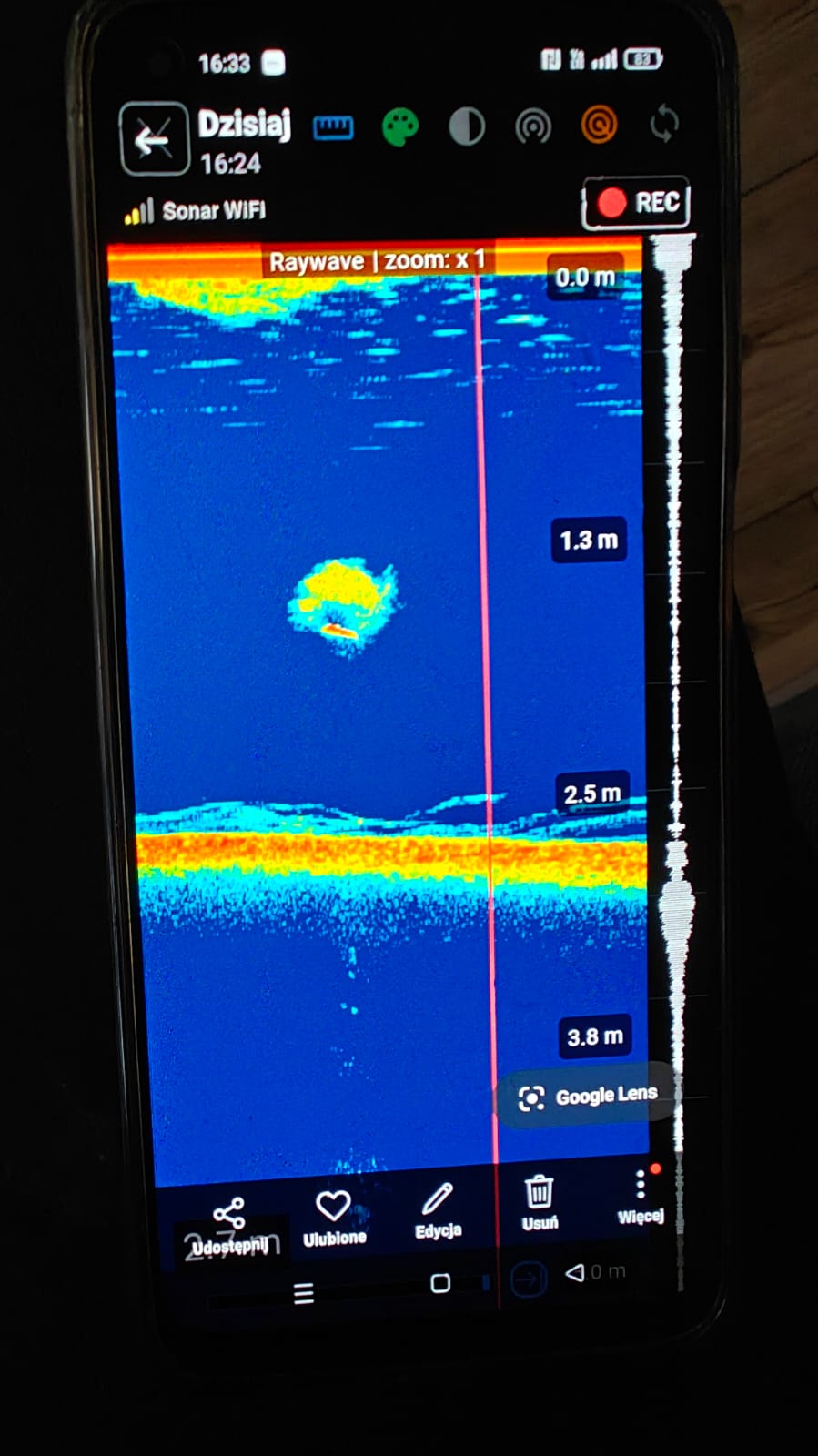
The image above perfectly shows how the narrow cone fish finder distinguishes the swim bladder of a fish – visible as a distinctly different color and located in the lower part of the carp’s abdomen. The bladder is filled with air, so the speed of sound propagation changes dramatically when encountering it, causing such a strong and characteristic reflection on the echogram screen.
Manufacturers of devices like Lowrance, Garmin, or Humminbird know very well that narrow cone fish finders with high frequency are the future of precise fishing because they allow for such detailed imaging.
Arches on Wide Cone 215 kHz – Classic View
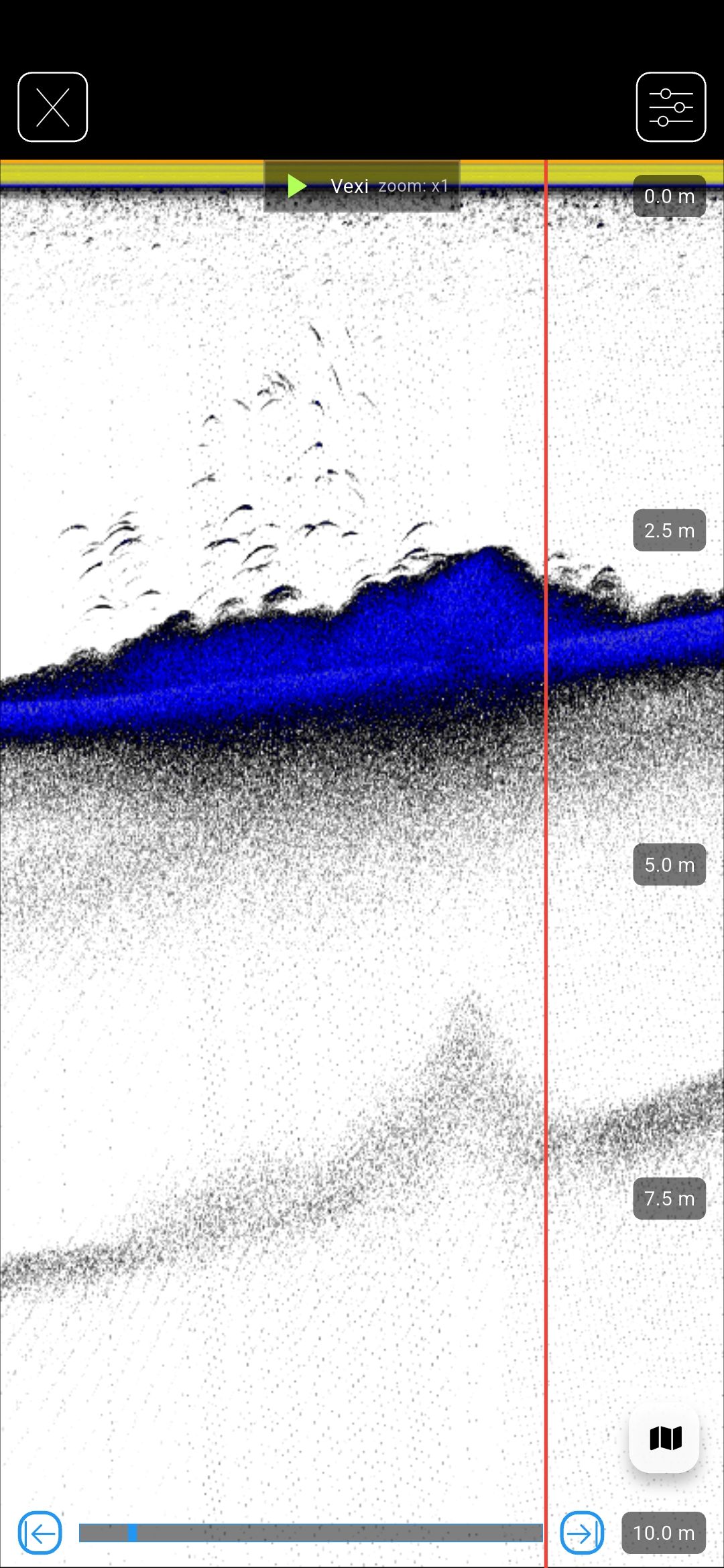
The image above shows the classic view of a wide cone fish finder at 215 kHz frequency. You see characteristic arches instead of clear “balls”. The fish are blurry, their shape is unreadable, and the exact location is only approximate.
That’s why with a wide cone setting and 200-210 kHz frequency, you’ll only see classic arches like in the last image above. However, a narrow cone fish finder with high frequency (715-810 kHz) will show you the true shape and exact position of fish.
Narrow Cone Fish Finder – Practical Fishing Applications
If you’re wondering whether a narrow cone fish finder is for you, consider the following scenarios:
When Will a Narrow Cone Fish Finder Work Perfectly?
- Carp fishing – precise location of resting carp
- Shallow and medium fisheries (up to 15 meters depth)
- Spot searching – accurate mapping of feeding areas
- Bait location – checking if fish approached the bait
- Species identification – different fish give different reflections
- Fish structure analysis – ability to see the swim bladder
Extreme-Master Sonar S300 – 800kHz Narrow Cone Fish Finder
Our flagship model Extreme-Master Sonar S300 is a professional narrow cone fish finder operating at 800kHz frequency. It offers:
- Ultra-narrow cone for maximum precision
- Clear fish imaging as “balls” and “clouds”
- Ability to see the swim bladder
- Water temperature sensor – additional information about conditions
- Compatibility with Extreme bait boats
- Easy installation and intuitive operation
- 2025 novelty – latest sonar technology
Learn more about the Extreme-Master Sonar S300 on the product page and see how a narrow cone fish finder can change your approach to fishing.
Summary – Narrow Cone vs Wide Cone Fish Finder
Summarizing the differences between fish finders:
- Narrow cone fish finder (715-810 kHz) – shows fish as balls, bubbles, and clouds. Allows you to see the swim bladder and exact fish structure. Ideal for precise carp fishing.
- Wide cone (215 kHz) – shows fish as classic arches. No details, approximate location. Better for deep waters.
Extreme One – here quality, accuracy, and full reliability count. That’s why our bait boats are compatible with the best narrow cone fish finders on the market.
Have questions about narrow cone fish finders? Contact us – we’ll be happy to help you choose the right model for your needs!

 Asystent pomocy Extreme One