
ALL IN ONE Bait Boat 2026 – Market Leader [Drone-Class Skydroid + AI Sonar + Multi-Camera + Offline Privacy]
The ALL IN ONE bait boat in 2026 is not what it was in 2016. Over the past decade, the market has evolved only incrementally – most manufacturers keep bolting new modules onto the same outdated radio electronics from the 2010s. EXTREME ONE takes a different path: we adopt drone-class technology used by professional industrial drones, agricultural drones, and mapping systems, and bring it fully into the bait boat segment. The result? A boat whose radio alone costs more than the complete control system of competitors – because it belongs to a different technological league entirely.
In this article, we show concretely how a true ALL IN ONE differs from the marketing slogan used by most of the market, why a 2010-era radio in a 2026 bait boat is a dead end, and exactly what we do differently to lead modern solutions.
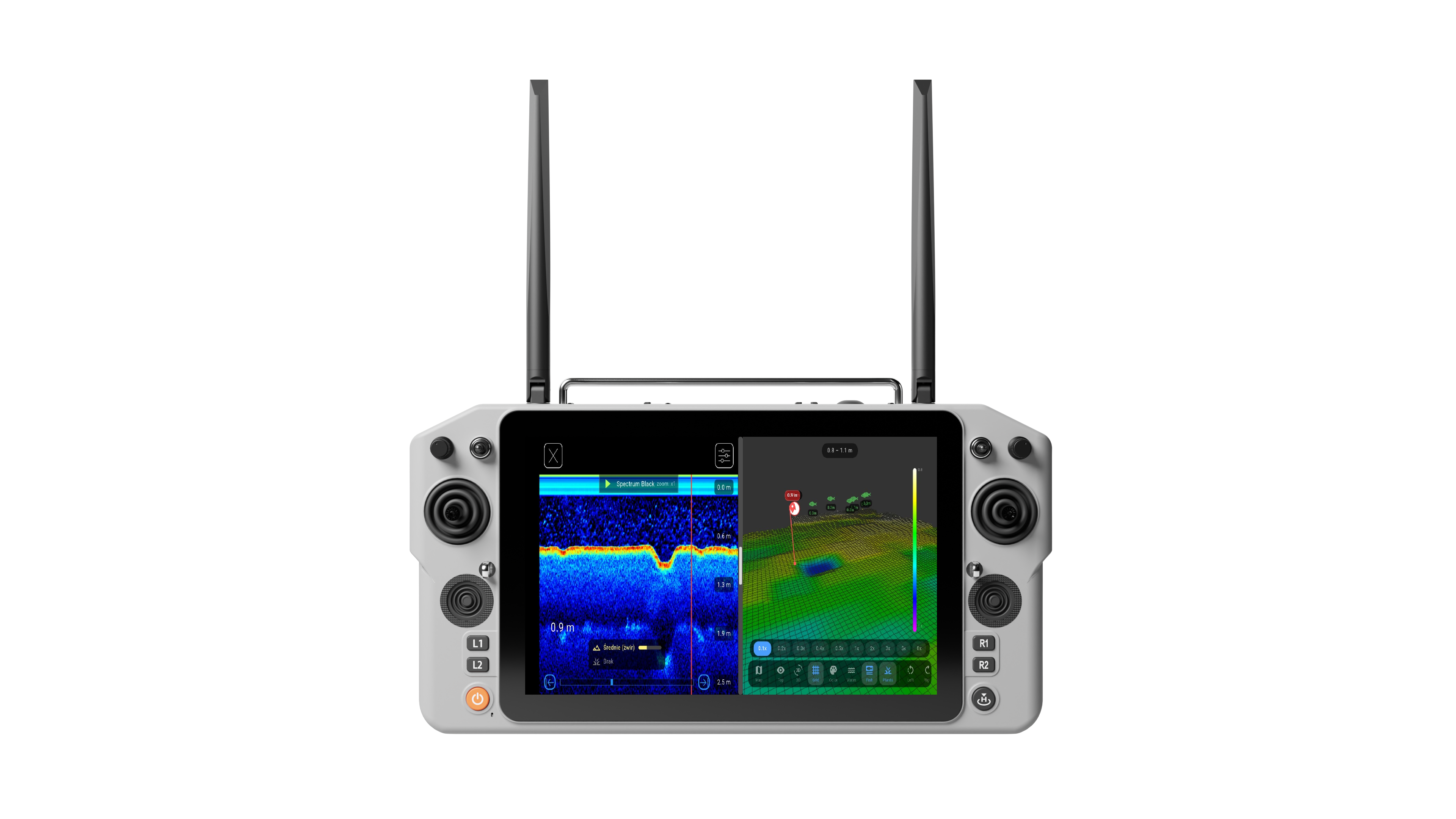
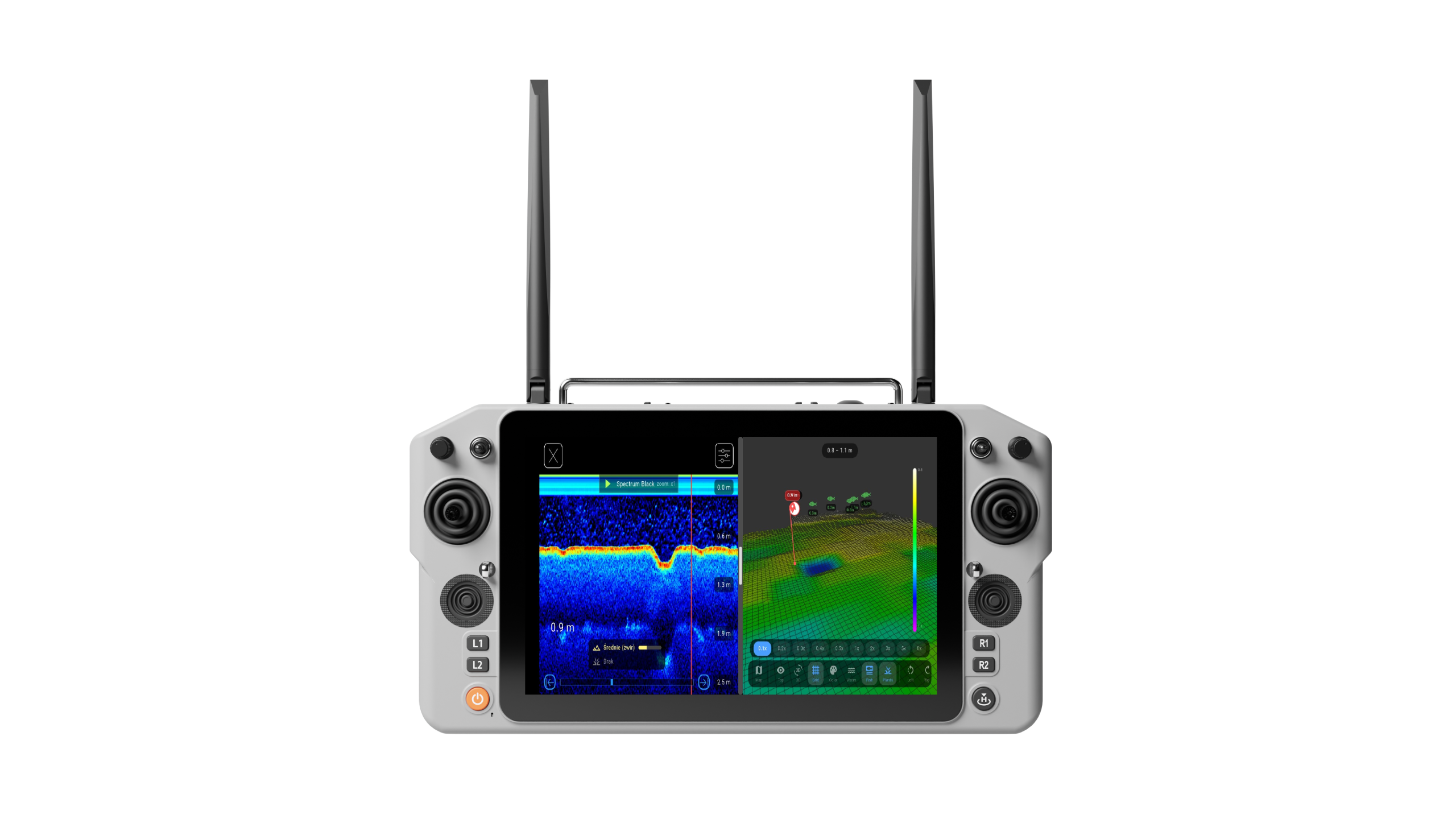
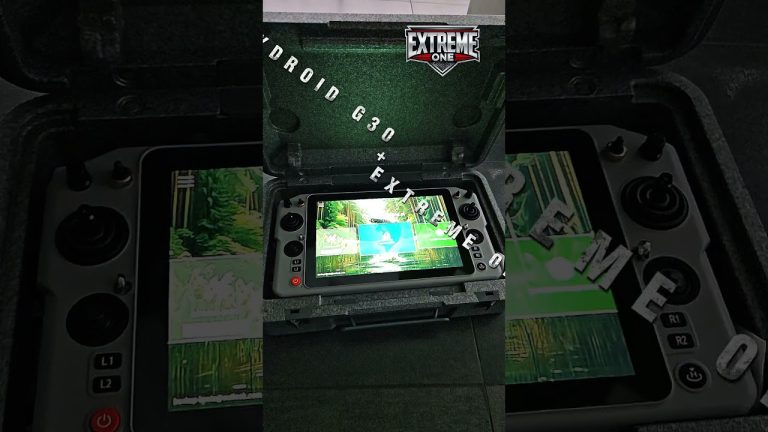
Skydroid G30 – flagship drone-class controller with 10.1″ display, used in EXTREME ONE as the ALL IN ONE control station
ALL IN ONE bait boat – what competitors offer, and what they fail to deliver
After reviewing the Polish and international markets (a dozen or so brands from the EU, UK, China, and Canada), a clear pattern emerges. Every manufacturer advertises a “complete system”, “all in one”, “autopilot with fish finder” – but once you dive into the specifications, the truth looks rather different:
- Manufacturer 1 – “all in one” means autopilot + an optional 200/83 kHz dual-beam fish finder from a third-party supplier; a camera doesn’t even exist in the kit, and the app is third-party.
- Manufacturer 2 – controller X with a touchscreen LCD displays the underwater camera feed up to 20 m – but no native app, no cloud, no GPS waypoint synchronization.
- Manufacturer 3 – flagship version with an 8″ tablet and a Raymarine fish finder, but everything is glued together via separate third-party apps.
- Manufacturer 4 (premium DE) – Raymarine Element HyperVision 1.2 MHz, RealVision 3D, proprietary app on a proprietary tablet (locked-down Android dedicated only to the autopilot – you can’t install YouTube, Netflix, or any custom app), radio range below ours, camera available only as a winch-down accessory (not under the hull), no AI bottom recognition.
- Manufacturer 5 (premium UK) – remote with LCD and a 455/115 kHz dual-beam fish finder, but no app at all, no cloud, no native camera.
The pattern is the same: “all in one” in the carp segment = autopilot + something else bolted on. There is no genuine integration into a single ecosystem with cloud synchronization, no AI in the sonars, no native app handling everything from one screen, no dual-band radio with auto-switching.
Pillar 1 – Drone-class radio vs outdated carp radios
This is the biggest technological difference and at the same time the least visible to the customer until they see the specifications side by side.
What the competition uses in 2026
After reviewing the market, most bait boats still operate on:
- FlySky FS-i6 / FS-i6X (the core of many Polish and European boats) – 2.4 GHz single-band, AFHDS 2A protocol, radio price: PLN 200–500, technology dating back to 2012.
- Proprietary LCD remotes – 2.4 GHz single-band, no advanced frequency hopping, no forward error correction.
- 433 MHz and 868 MHz radios – still present in the budget segment, even older technology.
The common denominator: single band, zero redundancy. When someone switches on Wi-Fi at the lakeside, when another remote operates nearby, when there is interference from a power line – the signal drops. In a single-band radio there is no plan B. When the band fails, the boat loses control.
What EXTREME ONE uses
The EXTREME ONE system runs on Skydroid G-series controllers (G16, G20, G30) – drone-class devices. Skydroid is a Chinese manufacturer of professional RC systems used in industrial mapping drones, agricultural drones (crop spraying), and surveillance systems. The cost of the radio alone in EXTREME ONE: PLN 3,000 (G16), PLN 3,500 (G20), PLN 4,500 (G30). That is 6–22 times more than the FlySky FS-i6X radio used in a typical bait boat (PLN 200–500) – because it is an entirely different technological league.
Skydroid (Quanzhou Skydroid Technology, China, since 2016) belongs to the top three global manufacturers of drone-class radio:
- DJI (Shenzhen, leader in the consumer/prosumer segment) – models DJI RC Pro Enterprise, RC Plus, RC 2, transmission system OcuSync O4 (up to 20 km, 120 ms latency, 1080p60). Closed ecosystem – DJI does not sell radio modules to integrators; it works only with its own drones.
- Skydroid – the same technological class as DJI, but with an open architecture enabling integration with third-party systems. That is why it is the only one of the top three suitable for deployment in our EXTREME ONE ecosystem for bait boats.
- SIYI Tech (Shenzhen) – Skydroid’s competitor in the integrator segment (MK15, MK32, HM30 models, 15 km range).
In the same technological league, but in different sub-segments, also operate: Herelink CubePilot (Australia, prosumer/professional), TBS Crossfire (long-range FPV), and FrSky Tandem (high-end hobby). All of these radios cost PLN 3,000–10,000 – because drone-class implies a reliability requirement on the order of 99.99% when there is equipment worth tens of thousands of zlotys in the air.
The flagship Skydroid G30 (10.1″ FHD 1920×1200, Qualcomm 6 nm, Android 14, fiber-optic FC for wired transmission, dual-band 2.4 + 5.8 GHz, 8 GB RAM / 128 GB ROM) is a direct counterpart of the DJI RC Pro Enterprise in the professional segment – both in price and technology. Meanwhile, competitors in bait boats still use FlySky FS-i6X radios from 2012 priced at PLN 200–500.
Full Android 14 with Google Play – not a closed proprietary system
The second enormous difference compared to premium competition: our Skydroid runs full Android 14 with access to the Google Play Store. This means that on the very same controller you use to pilot the boat, you can install anything – YouTube, Netflix, Spotify, a browser, hiking maps, weather forecasts, Discord to chat with friends, your banking app.
While the boat follows its autopilot route, you open YouTube and watch a match. The Skydroid controller acts as the boat’s transmitter, an Android tablet, a Wi-Fi router, and a smartphone with 4G internet – all in one drone-class device.
Premium competitors with proprietary tablets (e.g., a modified Android dedicated solely to the autopilot) have Google Play locked, with no possibility of installing third-party apps. It is a closed ecosystem – if the manufacturer disappears from the market, a controller costing PLN 5,000–8,000 becomes useless dead weight.
Skydroid runs on the standard Android Open Source Project (AOSP). Firmware updates via Google Play Services, independence from any single vendor, full freedom to install software.
4G/LTE SIM card – a feature no other bait boat manufacturer offers
After surveying more than a dozen bait boat brands from Poland, Germany, the United Kingdom, China, and Canada, not a single competitor offers a SIM slot in the boat’s control device. This is the exclusive domain of Skydroid (the G12, G16, G20, G30 models all ship with a factory 4G/LTE SIM slot – because that is a drone-class controller requirement).
What does a SIM card in the boat’s transmitter give you?
- Internet directly in the controller – satellite map updates, access to the EXTREME ONE cloud, with no need to tether from a phone
- Wi-Fi hotspot – the controller shares internet with other devices (phone, a friend’s laptop)
- Live streaming – broadcast the boat’s camera feed to YouTube/Facebook directly from the transmitter
- Cloud synchronization on-the-fly – every saved GPS waypoint goes straight to EXTREME ONE Cloud and is available on other devices
- OTA firmware updates – without going home, without nearby Wi-Fi
The competition lacks this feature because it uses hobby-grade remotes or simple LCD transmitters. Skydroid, as a drone-class controller, comes with a SIM slot as standard, because professional drone operators (mapping, agriculture, surveillance) demand it.
Self-healing dual-band 2.4 GHz + 5.8 GHz
The EXTREME ONE system uses two radio bands simultaneously with automatic switching:
- 2.4 GHz – greater range, better penetration of obstacles, but often congested (Wi-Fi, Bluetooth)
- 5.8 GHz – wider bandwidth, less interference, ideal for video
- Auto-switch – the system continuously monitors the quality of both bands (RSSI, BER, packet loss) in real time and dynamically switches to the better one. If one band fails, the other takes over without interrupting the signal
This is self-healing radio – a self-repairing link. A concept familiar from the professional drone segment and mesh systems, but practically absent in bait boats from other manufacturers. In practice it means: when the competition loses control under interference, we keep operating reliably.
Frequency Hopping Spread Spectrum (FHSS) and Forward Error Correction (FEC)
The Skydroid controller performs up to 1,600 frequency hops per second within the 2.4 GHz band, using OFDM modulation (Orthogonal Frequency-Division Multiplexing) and SDR (Software Defined Radio). It additionally applies LDPC FEC algorithms (Low-Density Parity-Check, Forward Error Correction) – the same algorithms used in NASA space transmissions and 5G networks.
What does this mean in practice? Packets lost to interference are reconstructed on the fly – there is no image “pixelation” or telemetry dropouts as in older-generation analog radios. This is the same technological layer used by FPV racing drones, where 0.1 seconds of transmission loss equals losing a PLN 5,000 machine.
Pillar 2 – H.265 compression and adaptive bitrate – how we squeeze 700 m out of CE-permitted power
European regulations (CE/RED 2014/53/EU) cap transmission power at 100 mW EIRP in the 2.4 GHz band, and in the 5 GHz band the limits depend on the sub-band: 200 mW in 5150-5350 MHz, up to 1 W (1000 mW) in 5470-5725 MHz with DFS/TPC mechanisms, and 25 mW in the SRD band 5725-5875 MHz. Manufacturers declaring “30 km range” in bait boats are either talking about the FCC market in the USA (where the 2.4 GHz limit is 1 W and 5 GHz reaches 4 W) or simply violating the RED directive. Physics is the same for everyone.
The question, then, is not “who lies more”, but who has the better technology stack within the same legal framework. EXTREME ONE leverages:
- H.265 (HEVC) compression – reduces bitrate by 40–50% at the same image quality compared to H.264. Coding Tree Units of 64×64 px (vs 16×16 in H.264) excel at encoding uniform regions such as water and sky – the typical view from a boat.
- Adaptive bitrate streaming – when SNR (signal-to-noise ratio) drops, the system smoothly lowers quality instead of losing the signal entirely. This is how FPV drones and streaming platforms operate.
- 170 ms latency – the measured time from event to on-screen display. That is FPV racing drone territory. Competitors using analog cameras or older codecs run at 300–500 ms.
The result: 700 m of range with full camera image + fish finder readout + telemetry + boat control – in full compliance with CE/RED standards, with no amplifiers, no non-standard antennas, on certified factory equipment.
Pillar 3 – AI EXTREME-MASTER SONAR S300 fish finder – 6 beams, up to 810 kHz, automatic bottom recognition
This is another area where the competition in the carp segment has remained stuck in the past.
What dominates the market
- Manufacturer 1 – Toslon TF520, single beam, 200 kHz, no AI
- Manufacturer 2 – Toslon TF640/TF740, dual beam 455/115 kHz, two beams (60° + 20°), no AI
- Manufacturer 3 (premium DE) – Raymarine Element HyperVision 1.2 MHz, RealVision 3D – the highest class available on the carp market, but no AI bottom recognition, no native integration with the controller’s app (separate tablet)
- Manufacturer 4 (premium UK) – proprietary dual-frequency fish finder, undeclared frequencies, no AI
EXTREME-MASTER SONAR S300
The EXTREME-MASTER SONAR S300 fish finder offers:
- 6 scanning beams (the most on the bait boat market) – from very narrow (point precision) to wide (terrain overview)
- Up to 810 kHz frequency – only a handful of boats worldwide carry sondes operating above 600 kHz; most run at 200/455 kHz
- Water temperature sensor – critical information in carp angling
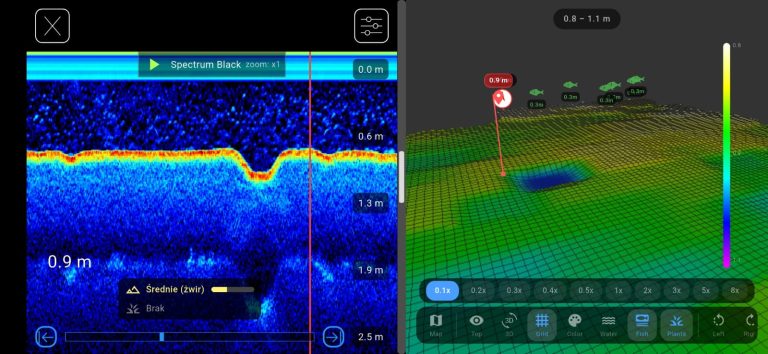
- 3D bottom scan with bathymetry – a real-time depth map
- Echogram recording with GPS position – return to the exact same spot
- AI bottom recognition – an algorithm classifies the bottom (hard/soft/silt, structures, vegetation) and the presence of fish. You don’t have to interpret the sonar image – the system does it for you.
What AI in a fish finder means in 2026
AI in sonars is the standard in the high-end saltwater segment: Garmin Panoptix LiveScope, Lowrance ActiveTarget 2, Deeper CHIRP+ 4 (openly advertising “AI Fish Detection” with an ML model trained by sonar experts). These sondes cost PLN 4,000–10,000 and are used by professional saltwater competitors.
EXTREME-MASTER SONAR S300 brings this technology to the carp segment as the first in Poland and one of the first in Europe. Algorithms based on YOLOv8 / Faster R-CNN (neural network architectures) classify the echo in real time and present the carp angler with a ready-made interpretation: where the bottom is hard, where vegetation begins, where the fish are.
Pillar 4 – Multi-camera system (and what no one else on the market has)
After reviewing the global market, the camera situation in bait boats looks like this:
- 99% of manufacturers – no camera in the kit; at best a third-party accessory
- Manufacturer 2 (PL) – a single VISION 360 underwater camera up to 20 m, touchscreen LCD, no native app, no cloud
- Manufacturer X (Canada) – integrated 360° underwater camera, 10″ remote, but not realistically available in Europe and at an exclusive price point
- Manufacturer 4 (premium DE) – only a wireless above-water camera as an option, no under-hull camera
What EXTREME ONE offers today
- Up to 3 cameras simultaneously on a single screen
- 170 ms latency – the image is practically LIVE
- Front-mounted boat camera – allows you to navigate precisely beneath trees, bushes, and reeds and deliver the bait rig in places inaccessible to camera-less boats (where the operator cannot see the obstacles)
- 360° gimbal – full camera rotation
- Recording + photos + cloud – material is saved and accessible from any device
2026 camera roadmap and modular mounting
In preparation (releases scheduled for the second half of 2026):
- Winch-down underwater camera (Q3 2026) – fully integrated with the Skydroid + EXTREME ONE system, controlled from the same screen, with no separate remote and no separate app. Submersion depth adjustable from the controller.
- Hull-embedded camera (Q4 2026) – lets you watch what is happening beneath the boat in shallow water (ideal for situations where the carp is right under the hull and the winch-down camera cannot fit between dense vegetation, or when the depth is only 0.5–1.5 m).
Modular camera mounting
The EXTREME ONE system architecture is open and modular. Each of the three camera systems can be:
- Mounted separately – if for now you only need the front camera, you can add the others a year or two later when the budget allows
- Mounted in an existing boat – the cameras are backward compatible with the EXTREME-PILOT autopilot; there is no need to buy a new boat
- Mounted as a retrofit – owners of EXTREME-PILOT from previous years can extend their system with a camera without replacing anything else
- Controlled from a single app – all 3 cameras + autopilot + fish finder on one Skydroid screen
This is a key difference compared with the competition, where the camera (if it exists in the offer at all) is permanently embedded into one specific boat model at the factory – want a camera, buy a new boat for PLN 8,000–15,000.
Once all three camera systems are introduced (front-mounted LIVE + winch-down underwater + hull-embedded), EXTREME ONE will be the only bait boat platform in the world with three independent, modularly mounted image channels integrated into a single ecosystem with cloud synchronization.
You switch EXTREME ONE on and it works – no pairing, no calibration, no fiddling
The advantage of an integrated system is most evident at the water’s edge. In a traditional setup with separate devices:
- You switch on the RC remote – wait for it to acquire the signal
- You switch on the tablet/phone – launch the autopilot app – pair with the receiver
- You launch a second app – the fish finder – connect via Wi-Fi/Bluetooth to the sonde
- You launch a third app – the camera – another pairing
- You calibrate the autopilot’s compass – swinging the boat in figure-eights
- You check the battery on each device separately
- At least 5–10 minutes before the first cast of the boat
With EXTREME ONE and the Skydroid controller:
- You press the power button on the Skydroid
- And that’s it
The EXTREME ONE app launches automatically. The autopilot map is already there – with the boat’s position, saved GPS waypoints, the most recently used venue. The echogram draws from the very first second the boat touches the water. The camera preview appears on screen with 170 ms latency. Telemetry – battery voltage, water temperature, speed, distance – everything is visible immediately.
There is no pairing. There is no compass calibration. No “select device from the list”. No “connect to the fish finder’s Wi-Fi”. No separate apps to install, log into, or configure. You switch it on – and it works. From the very first second.
This is the definition of true ALL IN ONE – not a marketing slogan, but a real user experience. Competitors offering a “complete kit” assembled from 3 separate devices by 3 manufacturers using 3 apps are not ALL IN ONE. They are a patchwork of components masquerading as a system.
Pillar 5 – Full offline operation, privacy, optional E2E cloud
EXTREME ONE works 100% offline – with no internet connection
This is the only system on the bait boat market that fully operates offline. No internet connection, no login required, no online activation. All key functions work locally:
- Generation of 2D and 3D bathymetric maps without internet – the boat sails, the fish finder scans, and the system draws the depth map in real time directly on the controller. No Wi-Fi, no LTE, no server required.
- Offline satellite maps – Google Maps and OpenStreetMap downloaded ahead of time at home, available in remote areas with no signal.
- GPS waypoints, autopilot, cameras, telemetry – everything works locally on the controller ↔ boat link.
- AI bottom recognition – the algorithm runs locally on the controller; it does not send the image to a cloud server.
The competition often requires an internet connection for login, license activation, or account verification. EXTREME ONE is engineered from the ground up as an offline-first system – the internet is an option, not a requirement.
Your scans, your spots, your privacy
For us, privacy is a top priority. This is the key difference from third-party apps that, by default, harvest your data (maps, waypoints, tracks) on their own servers.
- By default we send nothing – your bottom scans, bathymetric maps, GPS waypoints, and camera recordings stay locally on the controller. Without your consent, nothing leaves the device.
- No marketing telemetry – we do not analyze where you fish, we do not sell data, and we do not build behavioral profiles.
- No “share to use” condition – full functionality regardless of whether you activate the cloud.
This is a system designed for premium-class professional carp anglers who fish competitively and do not wish to share their spots, water-body maps, or bottom scans with anyone – not with the equipment manufacturer, not with a third-party app, and not with advertisers.
Optional private E2E cloud with your encryption key
If you want a backup of maps, echograms, and GPS waypoints, switch on the EXTREME ONE cloud. Even then you retain full control:
- End-to-end encryption (E2E) – the data is encrypted on your device with your private key before it leaves the controller.
- Private key stays only with you – we have no access to your key. That means even in the event of a server incident, your data is unreadable to anyone without the key – including us.
- Zero-knowledge architecture – the EXTREME ONE Cloud server stores only encrypted blobs. Without the key, they cannot be reconstructed, decoded, or displayed.
- Cross-device synchronization – the same key on a second controller, phone, or tablet decrypts the data locally.
Optional sharing – with a friend, a group, or the community
If you wish, you can share a map, waypoint, or echogram:
- With a specific friend – generate a link, send it, and they open it in EXTREME ONE
- With a closed group – e.g., your professional team or teammates
- With the entire EXTREME ONE community – a public spot database for those who want to share
But this is always your decision. By default, everything is private. Sharing is an option, not a requirement.
Use case – how it looks at a competition
A practical scenario – you arrive at a competition or a new venue:
- You launch the boat onto the water and switch on the Skydroid – everything starts from the very first second.
- You mark out the area to be mapped – draw a rectangle or polygon on the screen with your finger.
- The boat moves autonomously – it traces a path covering the entire area in a grid (mowing-the-lawn pattern), automatically scanning the bottom with the fish finder.
- Meanwhile you set up the bivvy, prepare the rods, brew tea – the system is working for you.
- After the scan you have a ready-made 2D + 3D bathymetric map with full depth information for every meter of the area.
- You select your spots – on the map you can see a plateau at 2 m, an edge, a hole, a bench.
- You verify each spot on the echogram – you see whether the bottom is hard, soft, or whether vegetation is present. AI classifies the structure automatically.
Bathymetric maps are only one piece – what’s on the bottom matters most
This is the key advantage we provide to carp anglers. What good is identifying a plateau at 2 m if it turns out to be silt or dense vegetation, and you have no way of knowing? Competing boats give you depth alone. We give you depth + bottom composition + presence of fish + water temperature, all unified within a single application.
In EXTREME ONE, every point on the bathymetric map is linked to its corresponding echogram fragment with precise GPS coordinates. Tap on the map – and you see the echogram from that exact spot. Spotted an interesting place on the map? Check what is below in a second.
That is the meaning of true ALL IN ONE – the bathymetric map is only the beginning. What matters most is exactly what lies on the bottom. Hard bottom or silt? Stones or sand? Vegetation or bare clay? Carp or crucian? Only a system combining autopilot, sonar, and AI bottom classification within a single ecosystem with native integration delivers that answer.
Comparison table – EXTREME ONE vs typical competition
| Parameter | Manufacturer 1 (entry segment) | Manufacturer 2 (mid segment) | Manufacturer 3 (premium segment) | EXTREME ONE 2026 |
|---|---|---|---|---|
| Radio class | FlySky 2.4 GHz, single-band | FlySky / proprietary LCD, single-band | Proprietary 2.4 GHz, single-band | Skydroid drone-class, dual-band 2.4 + 5.8 GHz |
| Radio price alone | PLN 200–500 | PLN 500–1,500 | PLN 1,500–2,500 | PLN 3,000–4,500 (Skydroid G16/G20/G30) |
| Self-healing | None | None | None | Dual-band auto-switch |
| EU range (CE) | 200–400 m | 400–600 m | 500–700 m | 700 m with full image |
| Fish finder | Single-beam 200 kHz | Dual-beam 455/115 kHz | 1.2 MHz HyperVision (separate device) | 6 beams, up to 810 kHz, AI |
| AI bottom recognition | None | None | None | Yes – automatic interpretation |
| Front LIVE camera | None | None / option | Wireless option | Yes, 170 ms latency, up to 3 cameras |
| Underwater camera | None | Yes (up to 20 m) | None / winch-down option | Q3 2026, Skydroid integration |
| Hull camera | None | None | None | Q4 2026 – the only one on the market |
| Native app | None / 3rd party | None / 3rd party | Proprietary tablet | EXTREME ONE – everything on a single screen |
| Operating system | LCD remote | LCD remote / dedicated Android | Proprietary Android (no Google Play) | Full Android 14 + Google Play |
| YouTube/Netflix/Spotify on the controller | Impossible | Impossible | Impossible | Yes – install whatever you want |
| 4G/LTE SIM slot in the controller | None | None | None | Yes – the only one on the market |
| Wi-Fi hotspot from the controller | None | None | None | Yes (Skydroid Android) |
| Full offline operation (2D/3D maps without internet) | Partial | Requires 3rd-party app | Requires tablet connection | Yes – 100% offline |
| Cloud / synchronization | None | None | None | EXTREME ONE Cloud (optional) |
| E2E encryption with your key | — | — | — | Yes – zero-knowledge |
| Your scans on the manufacturer’s server | Locally | Often sent to 3rd-party app | Sent to manufacturer’s app | By default never – only with consent and encrypted |
| AI bottom classification fused with the map | None | None | None (separate tools) | Yes – map + echogram + AI on a single screen |
| Modular camera mounting (retrofit) | None | None (built into the boat) | None (built into the boat) | Yes – each camera separately |
| Setup | Pairing + calibration | Pairing + compass calibration | Multi-step configuration | Switch on and go – zero calibration |
What is fading away in 2026 – and why it matters
The bait boat industry is at a turning point. The technologies that dominated for the past decade are giving way to drone-class and AI-driven solutions:
- 433 MHz and 868 MHz radios – yielding to dual-band 2.4 + 5.8 GHz
- Single-band 2.4 GHz without frequency hopping – yielding to FHSS with LDPC FEC
- No cloud – yielding to multi-device synchronization
- Single-beam 200 kHz fish finders – yielding to multi-beam units with AI
- Separate apps for each module – yielding to integrated ecosystems like EXTREME ONE
- Analog cameras with 500 ms latency – yielding to digital H.265 with 170 ms latency
- Manual sonar interpretation – yielding to AI with ready-made classification
It is like a carbureted engine in a 2026 car – it still works, but it is decade-old technology. EXTREME ONE is building the future: drone-class radio, AI sonar, multi-camera, cloud, ecosystem.
CE/RED reality check – why “30 km of range” in the EU is fiction
Legal limits in the European Union (ETSI EN 300 328 standard for 2.4 GHz, ECC Decision 2006/771/EC for 5.8 GHz):
- 2.4 GHz (2400-2483.5 MHz): maximum EIRP 100 mW
- 5 GHz Wi-Fi indoor (5150-5350 MHz): maximum EIRP 200 mW
- 5 GHz Wi-Fi outdoor (5470-5725 MHz): maximum EIRP up to 1 W (1000 mW) with DFS and TPC mechanisms
- 5.8 GHz SRD (5725-5875 MHz): maximum EIRP 25 mW (the typical band for FPV drone video)
The FCC in the USA permits 1 W on 2.4 GHz and 4 W on 5.8 GHz. That is where manufacturers’ “30 km” claims come from – they are true, but only outside the EU. Any equipment sold in the EU must meet CE/RED limits – physics is the same for every manufacturer.
The question is not “who claims the longest range” but who extracts the most from the permitted power. EXTREME ONE answers: dual-band 2.4 + 5.8 GHz operating simultaneously + LDPC FEC + H.265 + adaptive bitrate = a real 700 m with full image, while competitors operating within the same legal framework reach 200–500 m.
2026 development roadmap – what we are adding
- Q3 2026 – winch-down underwater camera with native Skydroid integration
- Q4 2026 – hull-embedded camera for monitoring at shallow depths
Once both systems are introduced, EXTREME ONE will be the only bait boat platform in the world with three independent image channels (front-mounted LIVE + winch-down underwater + hull-embedded) integrated within a single ecosystem with cloud synchronization.
Summary
The ALL IN ONE bait boat in 2026 no longer means “autopilot + something else”. It means: drone-class dual-band radio, AI fish finder with 6 beams / 810 kHz, multi-camera system with 170 ms latency, cloud, synchronization, and everything on a single screen.
EXTREME ONE is today the only system in the bait boat segment that meets this complete set of criteria. We work with technology that costs 6–22 times more than competitors’ radios, because it belongs to a different league – the very one used by Skydroid industrial drones, agricultural drones, and mapping operators. The second league is DJI with the RC Pro and RC Plus models for the professional segment. The rest of the bait boat market is still riding 2012-era FlySky.
You switch EXTREME ONE on – and everything works. Right away. No pairing, no calibration, no hunting for a device in the app, no connection setup. You press the power button on the Skydroid – the autopilot map draws itself, the echogram from the fish finder begins displaying the bottom immediately, the camera preview appears on screen within seconds. Switch on, and it works. That is the meaning of true ALL IN ONE.
You switch on the Skydroid – and everything works from the very first second. Autopilot, fish finder, camera, AI, cloud. No pairing, no calibration, no fiddling. That is true ALL IN ONE – and that is why we lead this market.
Related products
- EXTREME-PILOT rev.4 – GPS Autopilot for Bait Boat
- EXTREME-MASTER SONAR S300 – 810 kHz Fish Finder with AI
- Skydroid G30 – Flagship 10.1″ Drone-Class Station
- Skydroid G20 – 7″ Drone-Class Station
- Skydroid G16 – 7″ IP67 Drone-Class Station
Related articles
- ALL IN ONE Bait Boat – Complete Guide 2026
- Extreme One Skydroid 2026 – Autopilot + Fish Finder + Camera
- Bait Boat Autopilot – 2026 Guide
- Bait Boat Fish Finder – 2026 Ranking
External sources:
 Karpik Kroczek, asystent Extreme One