
What the seller forgot to mention – or how a car parking sensor gets sold as a “boat depth gauge”
Parking sensor pulled straight off a car bumper is now being sold as a cheap boat depth gauge, and no, physics did not get the memo.
You buy a “boat depth gauge”. Or a “fish finder that shows depth”. A black round probe, a cable, waterproof, a nice number on the display. It looks exactly like a fish finder should look. 🎣
Except very often it’s a car reversing sensor – the same one that beeps when you back up towards a post. The most popular model is the JSN-SR04T (ultrasonic, 40 kHz). Someone dropped it into a housing and called it a depth gauge. Now for the details – what they didn’t tell you.
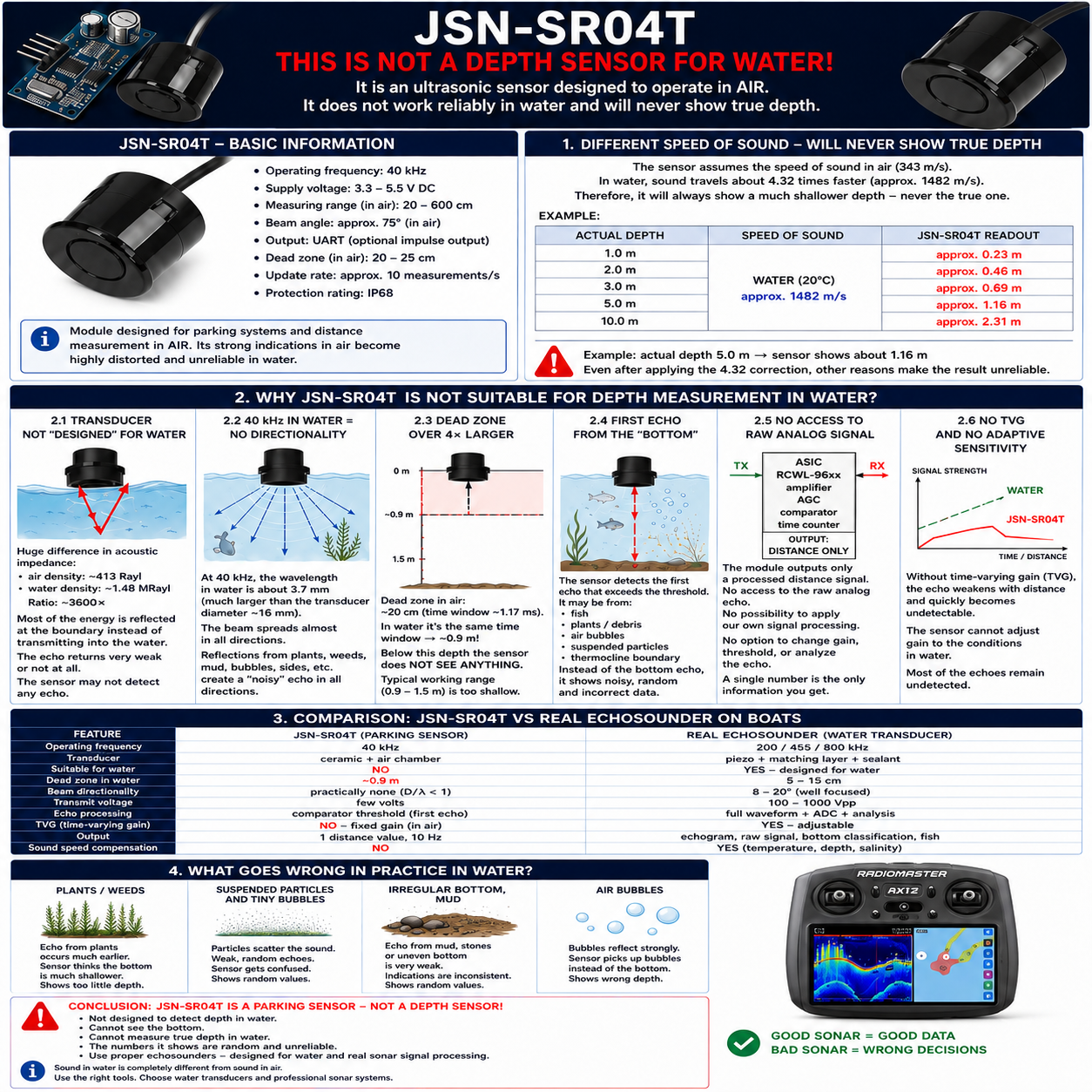
Why a parking sensor is not a fish finder: the short version
What hardware I test and on what legal basis
Every device described in this series was bought with my own money and is my property. I examine these units to know what actually reaches an angler’s hands and what I can demand from the hardware I design myself. The analysis covers one specific unit and the firmware version I found in it; other batches, versions and model variants may behave differently.
Observing, studying and testing how a program works in order to determine its underlying principles is permitted for a person who lawfully acquired the device: Article 75(2)(2) of the Polish Copyright Act, which implements Article 5(3) of Directive 2009/24/EC. The transmission capture involved only my own transmitter and my own receiver. I publish no source code, no memory dumps, no keys and no tools that would let anyone copy someone else’s software – only conclusions about what the hardware measures and what it does not.
Names and trademarks belong to their respective owners and are used solely to identify the hardware under review, as part of critical analysis and the right to inform. Photos taken from sales listings are used for the same purpose. If the manufacturer or the seller believes any conclusion is wrong, I will gladly repeat the measurements on a unit they provide and publish a correction.
In short: “waterproof” is not the same as “built to work underwater”. A waterproof sensor will survive rain and splashes, but it’s still designed to measure in air. This isn’t a nuance – it’s the heart of the problem.
1. It will show you a depth over four times too shallow
The sensor measures how long the sound takes to travel down and back, then converts that into metres – but it converts as if for air (343 m/s). And in water sound travels about 4.3 times faster (roughly 1480 m/s). It comes back much sooner, so the sensor “thinks”: if it returned that fast, it must be shallow.
In practice it looks like this:
| Actual depth | What the sensor shows |
|---|---|
| 1.0 m | ~0.23 m |
| 2.0 m | ~0.46 m |
| 3.0 m | ~0.69 m |
| 5.0 m | ~1.16 m |
| 10.0 m | ~2.31 m |
And here’s the thing: this one can actually be fixed – just multiply the result by about 4.3. If it were the only flaw, this would be a brilliant, cheap depth gauge. It isn’t. The rest you can’t fix by any means.
2. It barely “hears” anything underwater
Try shouting to a mate sitting underwater. He won’t hear you – the sound bounces off the surface instead of entering it. Exactly the same thing happens inside this sensor.
The reason is physics: an enormous acoustic impedance mismatch between the sensor’s diaphragm (designed for air) and water. Air is about 0.0004 MRayl, water about 1.48 MRayl – a difference on the order of thousands of times. The effect: nearly all the energy reflects at the boundary instead of entering the water, and whatever somehow returns from the bottom mostly won’t pass back inside either. That’s why there usually isn’t any sensible reading – zero, a dash, or a random number.
3. In shallow water it’s simply blind
After every “shout” the transducer keeps vibrating for a moment – like a bell after it’s struck. During that moment it hears nothing. In air this deaf dead zone is the first 20 cm or so. But in water sound travels 4 times faster, so that same interval corresponds to almost a metre of depth.
So near the bank, on the shallows, on the edges – exactly where a bait boat works most of the time (typically 0.5-1.5 m) – the sensor won’t see the bottom at all.
4. You don’t even know where it’s measuring
To measure precisely straight below you, you have to send out a narrow beam of sound – like a shaft of light from a torch. Underwater this sensor “glows” like a bare bulb: in all directions at once. At 40 kHz the wavelength in water is about 3.7 mm – less than the diameter of the transducer, so there’s nothing to form a directional beam from.
The result: the sensor catches reflections off the boat’s hull, off the propeller, off reeds two metres to the side. A number appears, it just has nothing to do with what’s beneath you.
5. It can’t tell the bottom from a fish
The sensor takes the first echo that crosses the threshold and says “that’s the bottom”. That’s it. It doesn’t analyse, doesn’t compare, doesn’t draw a chart. To it, the bottom is just as much:
- a band of weed or algae
- a bream that happened to swim past
- air bubbles from the propeller
- murky, algae-bloomed water or a thermocline
You get one number – no picture, no echogram, nothing. You have no way whatsoever to check whether you’ve just measured the bottom or a fish that swam under the boat.
6. And nobody’s going to fix it
The whole thing sits in one potted chip (an ASIC, e.g. RCWL-96xx): transmitter, amplifier, comparator, time counter – and a single number at the output. There’s no analogue signal brought out, you can’t tap into the receive chain, there’s no TVG (time-varying gain) which in a fish finder pulls out weak echoes from a deep bottom. There’s nothing in there to adjust, tweak, or resolder. The sensor was designed for parking, and for parking it’ll work just fine.
How it works in a real fish finder
A real transducer works at a completely different frequency (200 / 455 / 800 kHz), has a piezo transducer built specifically for water – with a matching layer and a backing damper – sends a narrow beam (8-20°) straight down, transmits with far more power (hundreds of volts), applies TVG and speed-of-sound compensation, and then draws a picture of the bottom. From that picture you can see for yourself whether under the boat there’s a hard bottom, silt, vegetation or a fish.
This isn’t a “better version” of a parking sensor. It’s a completely different device for a completely different job. If someone’s selling you a reversing sensor as a depth gauge – either they don’t know what they’re selling, or they do and they’re betting that you don’t.
A good sonar = good data. A bad sonar = wrong decisions on the water. That’s why in our kits we fit only transducers and fish finders designed to work in water – giving a real picture of the bottom, not a single number from a parking sensor.
Is a parking sensor a fish finder? The short answer
Let’s be clear: a JSN-SR04T parking sensor is built to measure the air gap between your bumper and a wall, not the depth of a lake. Its 40 kHz ultrasonic pulse barely couples into water, so a parking sensor will hand you noise instead of a fishable bottom trace. A real fish finder relies on a transducer tuned for water, with proper acoustic impedance matching, the right frequency and enough power to actually reach the bottom. So keep the parking sensor in your car, where it’s genuinely great, and use a device designed for water when you’re on the boat.

 Asystent pomocy Extreme One